Cookie preferences

 Español
 Français
 Deutsch
 Italiano
 Svenska
 Nederlands
 Português
 Dansk
Dansk
 Polski
 Română
 български език
 Magyar
 Čeština
 Slovenščina
 Slovenčina
 Русский
 中文
中文
 ελληνικά
What do the black, red, green and white labels on Iberico ham actually mean? Spain's official colour-coded seals...


What do the black, red, green and white labels on Iberico ham actually mean? Spain's official colour-coded seals...
Iberian Bellota ham is one of Spain’s greatest gastronomic treasures. Produced from Iberian pigs raised free-range in...
Iberico ham or Iberico shoulder: which should you choose? Although both come from Iberian pigs and follow similar...
Iberian Bellota ham is one of the most prestigious and iconic products in Spanish gastronomy. Its delicate texture, characteristic marbling, complex aromas and lingering flavour make it very different from an ordinary cured ham.
Behind the word Bellota lies an entire world: the unique genetics of the Iberian pig, the natural ecosystem known as the dehesa, the crucial free-range feeding period called montanera, and a slow curing process that can last several years.
There are also different categories of Bellota ham. An Iberian Bellota ham may come from a pig that is 50%, 75% or 100% Iberian. And contrary to a common misconception, Bellota and Pata Negra do not mean exactly the same thing.
In this guide, we explain what authentic Iberian Bellota ham is, how it is produced, how to recognise the different categories and what to consider when choosing one.
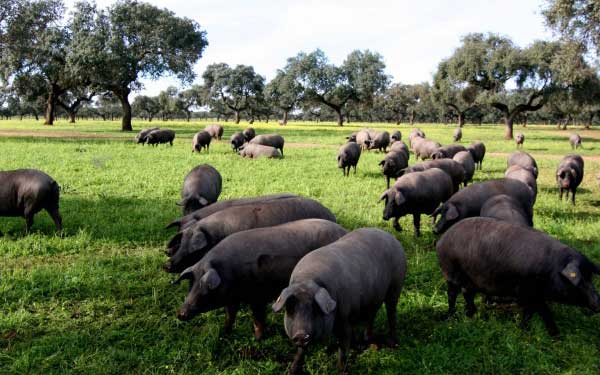
Iberian Bellota ham is produced from Iberian pigs, or authorised Iberian crossbreeds, whose final fattening period takes place free-range during the season known as the montanera.
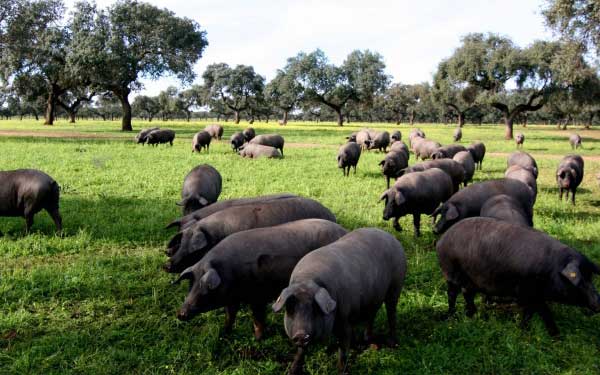
During this period, the pigs roam freely through the dehesa and feed primarily on acorns – bellotas in Spanish – together with grasses and other natural resources available in this unique environment.
This acorn-based feeding period is precisely where the term Bellota comes from.
Once the rearing period is complete, the hams undergo a long production process involving salting, resting, drying and maturation. For exceptional whole hams, the complete process can take several years.
Explore our selection of Iberian Bellota hams from carefully selected Spanish producers.
One of the keys to understanding Iberian ham is the pig itself.
The Iberian pig has a remarkable genetic ability to deposit fat within its muscle tissue. This creates the characteristic marbling visible in a slice of high-quality Iberian ham.
These fine streaks of fat are far more than a visual characteristic. They contribute significantly to the ham’s juiciness, texture and the way its aromas and flavours are perceived.
At the right serving temperature, the fat becomes soft and glossy and gradually melts in the mouth.
This genetic characteristic, combined with free-range activity, the diet during the montanera and the long curing process, is fundamental to the distinctive character of Iberian Bellota ham.
To understand Bellota ham, it is essential to understand the dehesa.
The dehesa is a distinctive ecosystem found in certain areas of the Iberian Peninsula. It consists of extensive grasslands dotted with trees, particularly holm oaks and cork oaks.
During the montanera, these trees provide the acorns that form an essential part of the pigs’ diet.
The animals roam freely and cover considerable distances while searching for food. This daily exercise, combined with their natural diet and Iberian genetics, contributes to the characteristics of both the meat and its fat.
The dehesa is therefore much more than the place where the pigs are raised. It is an integral part of the traditional Bellota production system.
The montanera is one of the most important stages in the production of Iberian Bellota ham.
It is the period when pigs destined for the Bellota category roam freely through the dehesa while the acorns ripen and fall naturally from the trees.
The pigs spend their days searching for food and consume significant quantities of acorns, together with grasses and other natural resources.
During the montanera, an Iberian pig may consume approximately 8 to 10 kg of acorns per day, although the actual amount varies according to the animal and the availability of food.
The combination of this diet and the exercise involved in roaming through the dehesa has a major influence on the characteristics of the meat and fat.
Acorns are at the heart of Bellota ham production. In fact, bellota means “acorn” in Spanish.
During the montanera, acorns form an essential part of the pigs’ diet alongside grasses and other natural resources found in the dehesa.
This diet, combined with the genetics of the Iberian pig and the physical activity of free-range rearing, influences the characteristics and distribution of its fat.
This is one of the fundamental differences between Bellota and other Iberian ham categories such as Cebo de Campo.
This is one of the most common sources of confusion when buying Iberian ham.
Bellota and Pata Negra are not synonyms.
The Bellota category includes different percentages of Iberian breed:
The term Pata Negra is reserved for 100% Iberian Bellota ham.
The distinction is therefore easy to remember: every Pata Negra ham is a 100% Iberian Bellota ham, but not every Iberian Bellota ham is Pata Negra.
If you are looking for this category, explore our selection of 100% Iberian Bellota Pata Negra hams.
The percentage shown on the label refers to the percentage of Iberian breed in the pig.
For a ham to be labelled 100% Iberian, both the mother and father must be pure-bred Iberian pigs registered in the appropriate herd book.
When it also meets the requirements of the Bellota category, it is the authentic Pata Negra.
This ham comes from an animal with 75% Iberian genetics. These pigs also undergo the montanera and meet the feeding and rearing requirements of the Bellota category.
A 50% Iberian Bellota ham comes from a pig with 50% Iberian genetics. Provided that the animal has completed the required montanera and meets the relevant production standards, it is fully entitled to the Bellota classification.
A percentage below 100% therefore does not mean that the product is not genuine Bellota ham. The percentage primarily describes the animal’s Iberian breed purity.
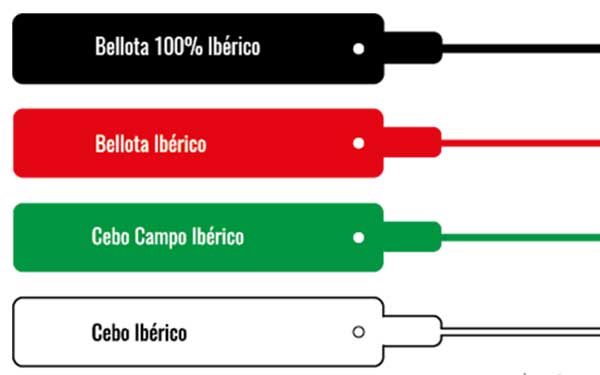
Spanish regulations establish a system of colour-coded seals to distinguish the main categories of Iberian ham.
For Bellota ham, two colours are particularly important:
Both are genuine Iberian Bellota hams, but only the black seal identifies a 100% Iberian Bellota ham that may use the Pata Negra designation.
The system also includes a green seal for Iberian Cebo de Campo and a white seal for Iberian Cebo.
The main difference lies in the animals’ diet and the conditions during the final stage of rearing.
Pigs destined to produce Bellota ham complete their final fattening stage during the montanera, roaming freely through the dehesa and feeding primarily on acorns and other natural resources.
Cebo de Campo also comes from Iberian pigs with access to outdoor areas, but their diet is based primarily on compound feed made from cereals and legumes, supplemented by natural resources available in their environment.
Cebo de Campo is genuine Iberian ham and can be an excellent choice for anyone looking for the distinctive characteristics of Iberian pork at a generally more accessible price than Bellota.
Explore our selection of Iberian Cebo de Campo hams.
When you look closely at a slice of good Iberian ham, you will often see fine streaks of white fat running through the meat.
This natural marbling is one of the most distinctive characteristics of the Iberian pig.
Its genetics favour the deposition of fat within the muscle. Diet and physical activity during the montanera also contribute to the characteristics of this fat.
During curing, the fat plays an important role in the ham’s evolution and in the development of its aromatic profile.
At the right temperature, it becomes glossy and begins to melt gently in the mouth, contributing to the ham’s succulent texture and helping release its aromas.
Once the rearing stage is complete, a slow and meticulous production process begins. Time, experience and careful control of each stage are essential.
The fresh hams are covered with salt for a carefully controlled period based on factors such as the weight and characteristics of each piece. This stage is essential for preservation and the subsequent maturation process.
After salting, the hams undergo a resting period during which the salt gradually distributes throughout the piece.
The hams are then transferred to drying rooms, where they gradually lose moisture while their texture and flavour begin to develop.
Finally comes the long curing period. Over months and years, the ham gradually develops its characteristic texture, aromas and flavours.
High-quality Iberian Bellota hams may be cured for approximately 36 to 48 months, although the exact duration depends on the weight and characteristics of each piece and on the producer’s methods.
There is no single flavour profile shared by every Bellota ham. The production area, genetics, raw material, producer and curing time can all create significant differences.
A high-quality Iberian Bellota ham generally offers a deep, lingering flavour, a succulent texture and remarkable aromatic complexity.
The marbled fat plays a fundamental role. When the ham is served at the right temperature, this fat gradually melts in the mouth, helping to carry and prolong its flavours.
The balance between lean meat, fat, salt and the aromas developed during curing is one of the defining characteristics of an exceptional ham.
The price of Bellota ham reflects a long, demanding and naturally limited production process.
The pigs require extensive areas of dehesa during the montanera. The amount of available acorns and other natural resources naturally limits the number of animals that can be raised under the required conditions.
Time is another essential factor. After rearing, several more years may be required before the finest hams are ready to be sold.
The hams also lose a significant proportion of their initial weight during drying and maturation.
The quality of the raw material, the land required for rearing, the lengthy curing process and the producer’s expertise all contribute to the value of the finest Bellota hams.
The history of Iberian ham is closely linked to several Spanish regions with extensive dehesa landscapes and a long tradition of producing and curing Iberian ham.
Jabugo, in the Sierra de Huelva in Andalusia, is probably one of the best-known names internationally and has a centuries-old tradition of ham production.
Extremadura contains some of Spain’s largest areas of dehesa and is another historic heartland of the Iberian pig.
Guijuelo, in Salamanca, and Los Pedroches, in Córdoba, are also renowned production areas.
Some hams are protected by a Protected Designation of Origin (PDO), which guarantees, among other requirements, a defined geographical origin and compliance with a specific production specification.
The producer and its expertise have a major influence on the final character of an Iberian ham.
One of the best-known names is Cinco Jotas 5J, closely associated with Jabugo and internationally recognised for its 100% Iberian Bellota ham.
Spain is also home to many other outstanding producers, each creating hams with different flavour profiles according to their origin, raw material and curing methods.
Explore our selection of Cinco Jotas 5J hams.
Iberian Bellota ham is available in several formats. The best option depends mainly on how often you intend to enjoy it and how you prefer to serve it.
A whole bone-in ham is the traditional Spanish presentation. Placed in a ham holder, it can be hand-carved gradually into very thin slices.
It is particularly suitable for regular consumption, celebrations and anyone who enjoys the ritual of traditional hand carving.
Boneless ham is particularly convenient for storage and slicing. It can be carved with a suitable knife or sliced very finely using an appropriate slicer.
Explore our selection of boneless Iberian ham.
Pre-sliced ham is the easiest way to enjoy Iberian ham without having to carve a whole piece.
Individual packs allow you to open only the quantity you need and are particularly convenient for tapas, appetisers or occasional tasting.
Discover our selection of sliced Iberian ham.
An exceptional Bellota ham needs very little preparation. Serving it correctly is far more important.
The slices should be thin, and the ham should not be served too cold.
At the right temperature, the marbled fat becomes slightly glossy and soft, allowing the aromas and flavours to express themselves more fully.
If sliced ham has been stored chilled, remove the pack sufficiently in advance of serving so that the ham can gradually reach a more suitable tasting temperature.
Bellota ham can be enjoyed on its own to appreciate its full complexity or simply served with good bread.
The correct storage method depends on the format.
A whole bone-in ham should be kept in a cool, dry place away from direct sunlight and sources of heat. Once carving has begun, the exposed surface should be properly protected to prevent excessive drying.
Boneless ham and sliced packs should be stored according to the instructions provided on their packaging.
It is important to distinguish between the correct storage temperature and the ideal serving temperature.
When comparing Bellota hams, it is worth considering several factors rather than focusing only on the brand or price.
Considering these criteria makes it easier to compare products properly and choose a ham that suits both your preferences and your budget.
If you are looking for the highest category established under the Iberian ham quality standard, choose a 100% Iberian Bellota ham. This is authentic Pata Negra and is identified by the black seal.
50% and 75% Iberian Bellota hams can also offer exceptional quality. They undergo the montanera and fully belong to the Bellota category.
The decision should therefore not be based on breed percentage alone. The producer, quality of the raw material, origin and curing process all have a fundamental influence on the finished ham.
Buying Iberian Bellota ham online makes it easy to compare producers, Iberian breed percentages, curing times and formats.
Before choosing, check whether the ham is 50%, 75% or 100% Iberian Bellota and select the format that best suits your needs: whole, boneless or sliced.
At Gourmet Madrid, we select hams from recognised Spanish producers to offer a range of origins, categories and formats.
Explore our complete range of Iberian ham and compare our selection of Iberian Bellota ham.
Iberian Bellota ham is much more than a cured ham. It is the result of a unique combination of Iberian genetics, the dehesa ecosystem, the montanera, an acorn-rich diet and years of traditional curing expertise.
From free-range rearing to slow maturation in the cellar, every stage contributes to its characteristic marbling, melt-in-the-mouth texture and remarkable aromatic complexity.
The essential distinction is simple: Bellota identifies a category linked to the pigs’ feeding and rearing conditions during their final stage, while Pata Negra is reserved exclusively for 100% Iberian Bellota ham.
Discover our 100% Iberian Bellota Pata Negra hams, our selection of Iberian Bellota hams, our boneless Iberian hams and our sliced Iberian hams.
 Iberico Ham vs Iberico Shoulder: Differences, Curing, Yield and Which to Choose
Iberico Ham Labels Explained: Black, Red, Green and White
Iberico Ham vs Iberico Shoulder: Differences, Curing, Yield and Which to Choose
Iberico Ham Labels Explained: Black, Red, Green and White