Cookie preferences

 Español
 Français
 Deutsch
 Italiano
 Svenska
 Nederlands
 Português
 Dansk
Dansk
 Polski
 Română
 български език
 Magyar
 Čeština
 Slovenščina
 Slovenčina
 Русский
 中文
中文
 ελληνικά
What do the black, red, green and white labels on Iberico ham actually mean? Spain's official colour-coded seals...


What do the black, red, green and white labels on Iberico ham actually mean? Spain's official colour-coded seals...
Iberian Bellota ham is one of Spain’s greatest gastronomic treasures. Produced from Iberian pigs raised free-range in...
Iberico ham or Iberico shoulder: which should you choose? Although both come from Iberian pigs and follow similar...
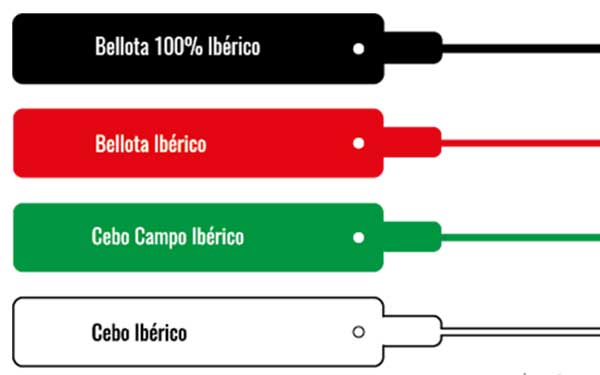
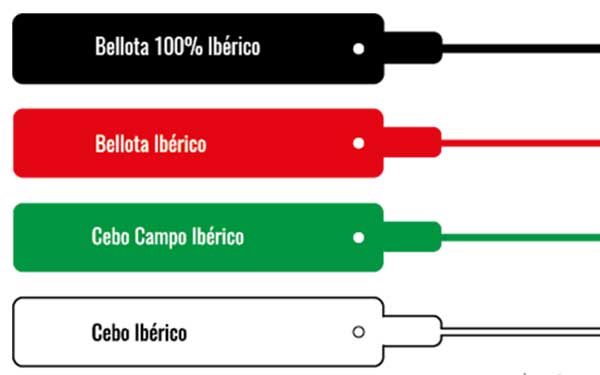
When buying Iberico ham, one of the easiest ways to understand exactly what you are getting is to look at the colour-coded seal attached to the ham.
Black, red, green or white: these four colours are not simply part of the producer's packaging or branding. They belong to Spain's official classification system for Iberian products.
The colour provides important information about the category of the ham, particularly the pig's diet and rearing system and, for Bellota products, its Iberian breed percentage.
However, terms such as Bellota, Pata Negra, 100% Ibérico, Cebo de Campo and Cebo can be confusing. Is every Bellota ham Pata Negra? What is the difference between a black and a red label? Is green-label ham still genuine Iberico ham?
This guide explains the four Iberico ham colour codes and how to use them when choosing a ham.
Spain uses an official system of colour-coded seals for Iberico ham to distinguish the principal categories established under the Iberian Quality Standard.
There are four colours:
This classification makes it easier to distinguish between hams that may look similar but come from pigs raised and fed under different conditions.
When choosing a ham, it is therefore worth looking beyond marketing descriptions and the appearance of the leg. The official colour seal provides valuable information about its category.
The black seal identifies the highest category under the Spanish Iberian Quality Standard: Bellota 100% Ibérico ham.
To qualify for this category, the pig must be 100% Iberian breed. Both its mother and father must therefore meet the requirements for pure-bred Iberian pigs.
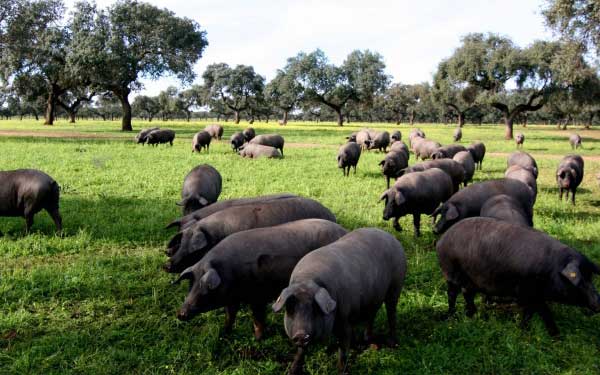
During the final fattening stage, the pigs also go through the traditional montanera, roaming freely in the dehesa and feeding primarily on acorns, grasses and other natural resources.
The black seal has another important meaning: this is the only category legally entitled to use the term Pata Negra.
In simple terms:
Pata Negra = Bellota 100% Ibérico = black seal.
If you are looking for this category, discover our selection of Pata Negra 100% Iberico Bellota ham.
No. This is one of the most common misconceptions about Iberico ham.
A ham can be genuine Bellota without being 100% Iberian breed.
Bellota refers to a category determined, among other requirements, by the pig's diet and rearing conditions during its final fattening period. The percentage — 100%, 75% or 50% Ibérico — refers to the pig's Iberian breed percentage.
This is why both black-seal and red-seal Bellota hams exist.
Only Bellota 100% Ibérico with a black seal may legally be called Pata Negra.
The red seal also identifies genuine Bellota ham.
The main difference compared with the black seal is the percentage of Iberian breed.
Red-seal Bellota ham comes from pigs that are:
These pigs also go through the montanera, roaming in the dehesa and feeding mainly on acorns and other natural resources during the final fattening period.
A red seal therefore does not mean Cebo or a lower feeding category. It identifies genuine Bellota Iberico ham.
The essential difference is that the pig is not 100% Iberian breed, so the resulting ham cannot legally be marketed as Pata Negra.
Both black and red seals identify Bellota ham.
The easiest way to remember the distinction is:
In both cases, the pigs undergo the montanera in the dehesa and meet the requirements established for the Bellota category.
This also means that a 50% or 75% Bellota should not automatically be considered an inferior-quality ham. Breed percentage is only one factor. The quality of the raw material, producer, region, curing process and ageing time can all have a major influence on the final product.
Explore our complete range of Iberico Bellota ham.
The green seal identifies Cebo de Campo Ibérico ham.
These pigs have access to outdoor areas and space to move around, but their final feeding stage does not follow the montanera system required for Bellota.
Their diet is based mainly on feed made from cereals and pulses, supplemented by natural resources available outdoors.
Cebo de Campo is still genuine Iberico ham and can offer excellent value for money.
It is particularly attractive for anyone looking for the distinctive qualities of Iberian pork without necessarily moving into the price range of Bellota ham.
Discover our selection of Iberico Cebo de Campo ham.
The white seal identifies Cebo Ibérico ham.
These pigs are fed mainly on compound feeds based on cereals and pulses and are raised under more intensive conditions than Cebo de Campo or Bellota pigs.
It remains an Iberico product when it meets the requirements established by Spanish regulations, but it belongs to a different category.
The white seal makes it easy for consumers to distinguish Cebo Ibérico from Cebo de Campo and Bellota products.
The four categories can be summarised very simply:
BLACK SEAL
Bellota 100% Ibérico
Authentic Pata Negra
RED SEAL
Bellota Ibérico
50% or 75% Iberian breed
GREEN SEAL
Cebo de Campo Ibérico
Outdoor access
WHITE SEAL
Cebo Ibérico
Primarily feed-based diet
Remembering these four colours is one of the simplest ways to understand the main Iberico ham grades.
Alongside the colour seal, another important piece of information is the Iberian breed percentage.
The most common designations are:
This percentage refers to the animal's genetics. It should not be confused with its diet.
For example, you can find both Bellota 50% Ibérico and Cebo de Campo 50% Ibérico. They have the same Iberian breed percentage but belong to different categories because their feeding and rearing systems differ.
The term Pata Negra has often been used loosely outside Spain to describe premium Iberico ham.
Under current Spanish regulations, however, it has a much more precise meaning.
Pata Negra is reserved for Bellota 100% Ibérico ham.
A ham must therefore meet both of these conditions:
This combination is identified by the black seal.
No. The colour of the hoof alone does not determine the official category of an Iberico ham.
Although the expression Pata Negra literally evokes a “black hoof”, visual appearance alone should never be used to identify Bellota 100% Ibérico.
To establish the category correctly, check the official seal and full product label.
This is particularly important when buying a whole ham from an unfamiliar producer.
To understand the black and red seals, it is also useful to understand the montanera.
The montanera is the final fattening period for pigs destined for the Bellota category. It takes place in the dehesa when acorns ripen and naturally fall from holm and cork oak trees.
During this period, the pigs roam freely, covering considerable distances in search of food and consuming primarily acorns, grasses and other natural resources.
An Iberian pig may consume approximately 8–10 kg of acorns per day during this period, although the actual amount varies according to the animal and the availability of food.
The combination of this diet and natural exercise plays an important role in the characteristics of the resulting Bellota ham.
Before choosing a ham, it is worth checking several pieces of information.
A ham should not be judged on any single factor. Final quality results from a combination of genetics, diet, raw material, craftsmanship and curing.
There is no single answer because the best choice depends on what you are looking for and your budget.
If you want the highest category established by the Spanish Iberian Quality Standard, the black seal identifies Bellota 100% Ibérico, or Pata Negra.
The red seal gives you genuine Bellota ham from pigs with 50% or 75% Iberian genetics.
The green seal identifies Cebo de Campo Ibérico, an interesting choice for anyone looking for genuine Iberico ham at a generally more accessible price than Bellota.
Finally, the white seal identifies Cebo Ibérico.
Understanding the differences allows you to compare hams that genuinely belong to the same category.
Understanding Iberico ham labels and colour codes makes it much easier to compare products, producers and prices.
A black, red, green or white seal immediately tells you the product category, but you should also read the full designation and Iberian breed percentage shown on the label.
At Gourmet Madrid, we select hams from different Spanish producers, regions and categories, with options ranging from Bellota and Pata Negra to Cebo de Campo and different presentation formats.
Explore our complete range of Iberico ham, discover our Pata Negra 100% Iberico Bellota ham or compare our selection of Iberico Bellota ham.
The official colour system makes the main categories of Iberico ham much easier to understand.
The basic rule is simple: black for Bellota 100% Ibérico and Pata Negra; red for Bellota 50% or 75% Ibérico; green for Cebo de Campo Ibérico; and white for Cebo Ibérico.
The colour is only the starting point. When choosing a quality ham, it is also worth considering the producer, origin, Iberian breed percentage, production method and curing time.
Once you understand the labels and colour-coded seals, it becomes much easier to know exactly which type of Iberico ham you are buying.
 Iberico Ham vs Iberico Shoulder: Differences, Curing, Yield and Which to Choose
Iberian Bellota Ham: Spain’s Gastronomic Treasure
Iberico Ham vs Iberico Shoulder: Differences, Curing, Yield and Which to Choose
Iberian Bellota Ham: Spain’s Gastronomic Treasure